
I’ve been thinking lately about the bits and bobs of kit or clothing that I get most use out of in life. Not necessarily the best or most specialist stuff, but the things I reach for again and again. My favourite worn-in Akubra Campdraft fedora; my Alt-Berg Defender boots; my old leather holdall, or my faded red fisherman’s smock that I use for gardening, kayaking and everything in-between. The 60/40 polycotton cagoule that I wear on standard moorland bimbles so I can save my swanky £500 Klättermusen one for the big trips.
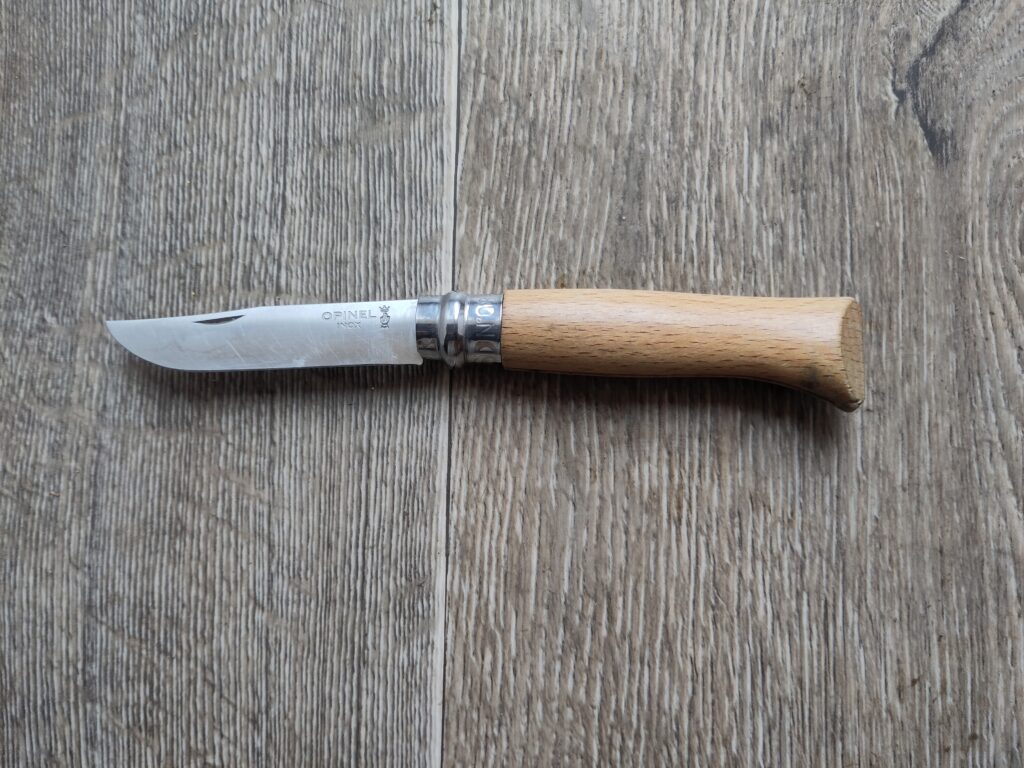
I’ll perhaps come to some or all of those things in due course, but I’m going to start with a design classic that lives in my trouser pocket – the Opinel No. 8 folding knife.
The French Alps, 1998
I’ve had an Opinel since the summer I turned 15, when I went on a French exchange to Sallanches, near Chamonix. The family I stayed with were seasoned alpinists, and when we sat down for lunches of bread and cheese on our walks, it was invariably an Opinel that came out of someone’s bag or pocket to do the honours.
It was never ‘mon couteau’ – always, ‘mon Opinel’. Rather like a Stetson or a Hoover or a Thermos or whatever, it’s one of those where the brand name has become shorthand for the thing. I coveted one immediately, and what with it being both France and the 1990s there was no age verification nonsense to stand in my way.

Shaving tinder or battling the Dark Lord
Since Joseph Opinel set up shop in the 1890s, the company has sold vast numbers of these simple wooden-handled working knives. Cheap and practical with minimal components (just five, in fact), their slim, sharp blades work well for fiddly everyday tasks like food prep, whittling, opening parcels or gutting fish. They’re quick and easy to sharpen up, and mine often finds its way onto the dining table in lieu of a steak knife.
The Opinel factory in Chambéry cranks out around 6.5 million knives a year, and I suspect most of us have owned or used them at some point. I came across one just recently in the pages of Eric Newby’s 1984 travelogue, On the Shores of the Mediterranean. They’ve found their way into the pockets of everyone from Dame Ellen MacArthur to Pablo Picasso – and unless my eyes deceive me, even Albus Dumbledore kept one handy.
Simpler, cheaper, better
I’ve owned plenty of penknives over the years, but somehow it’s almost always the Opinel that finds its way into my pocket or backpack. Perhaps partly because it’s so cheap and cheerful. You’re not afraid of breaking or losing it, since you can just pick up a replacement for a tenner.
That first one I bought in 1998 was a No. 7 in carbon steel with the standard beech handle. I think I still have it in a drawer somewhere – though the blade is heavily tarnished and I snapped the tip off opening a tin of enamel paint. Since then, I’ve always bought the stainless blades and gone for the slightly larger No. 8 size that fits my hand better.
I’ve lost a few and replaced them, sometimes finding them again later and sometimes not. One was liberated from my ownership along with the rest of my luggage when I checked it in at Sheremetyevo airport. I had another one with an olive wood handle that smelled delicious, but it went astray during a search for a lost dog and I’ve no idea what happened to it.
To lock or not to lock?
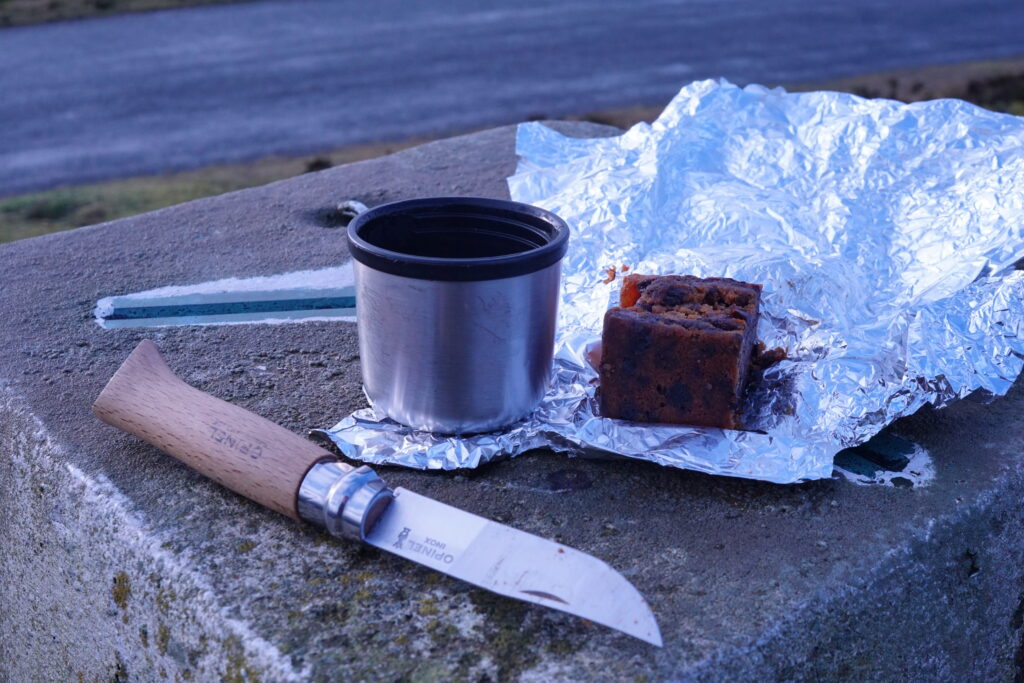
The only slightly sticky thing about an Opinel is the Virobloc ring. Added to the design in the 1950s, it’s a simple twist-lock mechanism that means you need a ‘good reason’ to carry one in the UK (as you would for a fixed-blade knife).
You can remove them quite easily, but I never have because being able to lock the blade makes it much safer for everyday tasks. I think sense probably needs to prevail in these circumstances, rather than getting hung up on what’s ‘legal everyday carry’ or not.*
I’m a grown man living an outdoorsy life in a rural area, and a pocket knife is useful. In the past week I’ve used it to feather kindling sticks, open boxes, eat a packed lunch and tidy up a grave (I know, I know…) – all of which are easier with a locking blade. I have no intention of shanking anyone with it, and if I go into town or anywhere else I’m not going to need it, the knife stays at home.
Always better for a bit of wear
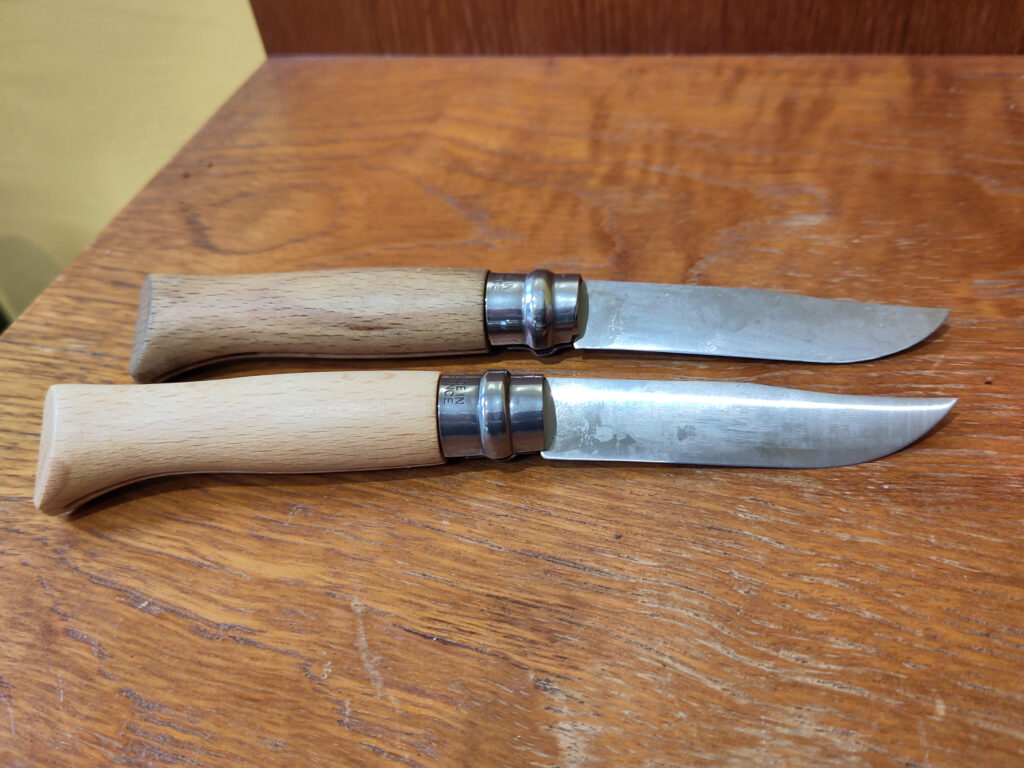
I’m a sucker for things that are nicely worn in, and my current Opinel is well on the way. The beech handle is burnished and discoloured with use, and when I place it next to the one I recently put in my girlfriend’s Christmas stocking, the blade is noticeably shallower from years of sharpening.
Hopefully I’ll get many more years of use out of it – but if I don’t, a new one costs less than a London pint.
*In fact, UK knife law is not nearly so black and white as most people think. Even a ‘legal’ (non-locking, less than 3-inch) blade can be considered a weapon depending on context, so if in doubt, you’re better off leaving it behind. I speak as a man who once accidentally went to an art gallery with a Swiss army knife in my pocket after fixing some door handles at my London flat. I set off the metal detectors and the security men had a very happy time lecturing me about my criminality.


Lovely stuff. I also have a much-loved Opinel No.8 with a walnut handle, as well as its baby brother – might be a No.4? – which is really more novelty than tool, but handily fits inside a roll of gear repair tape for life on the trail. A highly inoffensive weapon, but a very useful thing for little tent tasks (popping blisters, mostly…)
Matt Jones